


For years, Wisconsin Democrats have introduced sweeping election bills, only to watch their proposals die in the Republican-controlled Legislature.
Those days, for at least the next two years, are over.
Tuesday’s elections delivered a blue wave across Wisconsin, with Democrats flipping both the State Assembly and State Senate while David Crowley captured the Governor’s Office. For the first time since 2010, Democrats will have complete control of state government.
While Democrats often campaign as moderates focused on affordability, healthcare, and education, their legislative agenda tells a far more progressive story.
For years, Democratic lawmakers have proposed fundamentally changing how Wisconsinites register to vote, cast their ballots, and elect their representatives. Republican majorities prevented those bills from becoming law.
Now, those roadblocks are gone.
From automatic voter registration and ranked-choice voting to the National Popular Vote Compact and taxpayer-funded judicial campaigns, we don’t have to guess what Democrats want to do to Wisconsin elections. They’ve already laid out their agenda.
Here are some of the proposals that could find new life under a Democratic trifecta.
Driver’s Licenses for Illegal Immigrants and Automatic Voter Registration
Incoming Secretary of State JoCasta Zamarrippa has identified granting driver’s licenses to undocumented immigrants as a top legislative priority, a policy Governor-elect David Crowley previously supported.
Supporters argue the policy would improve public safety by ensuring more motorists are trained, tested, and insured. Of course, anyone who has driven next to someone from Illinois on I-94 knows that possessing a driver’s license doesn’t necessarily make someone a safe driver.
But the bigger concern is how this proposal could intersect with Democrats’ push for automatic voter registration.
Under current law, noncitizens are prohibited from voting in Wisconsin elections. However, the state does not generally require proof of citizenship when registering to vote.
Under 2025 AB 920, Democrats proposed automatically registering eligible individuals through the Department of Transportation. Combined with driver’s licenses for undocumented immigrants, the proposal raises serious questions about how election officials would distinguish eligible citizens from noncitizens before adding individuals to the voter rolls.
The legislation would also establish automatic registration through the University of Wisconsin System, raising additional concerns about ensuring nonresident students meet Wisconsin’s voter eligibility requirements.
While noncitizen voting would remain illegal, expanding automatic registration without sufficient citizenship verification could create opportunities for ineligible individuals to enter the system. This is by design.
The National Popular Vote: What Happens When Wisconsin Votes for the Wrong Candidate?
Wisconsin is one of America’s most important presidential battleground states. Every four years, candidates spend millions of dollars and countless hours courting voters here, giving the Badger State an outsized voice in determining the nation’s future.
But under legislation introduced by Wisconsin Democrats, that influence would be erased while large, Democrat states on the East and West Coasts gain an outsized influence over the presidency.
2025 AB 1152 would enter Wisconsin into the National Popular Vote Interstate Compact, awarding the state’s ten electoral votes to the candidate who wins the nationwide popular vote, regardless of whom Wisconsin voters actually supported.
Consider the implications.
If a Republican wins Wisconsin but a Democrat wins the national popular vote, Wisconsin’s electoral votes would go to the Democrat, effectively overriding the choice made by the majority of voters in our state. Rather than casting the Republican slate of electors for the Republican candidate, an alternate slate of Democratic electors would be cast for the Democratic nominee — even though they didn’t carry our state.
The compact would take effect once participating states collectively control at least 270 electoral votes. Currently, 18 states have joined, including California, New York, Minnesota, and Illinois.
For a state accustomed to playing a decisive role in presidential elections, that’s no small change.
Instead of fighting for votes in Wisconsin, presidential candidates could increasingly concentrate their attention on large population centers, leaving the farmers and factory workers of middle America with less political influence.
Many Wisconsinites already feel as though their vote doesn’t matter. Under the National Popular Vote Compact, they could watch their own state’s electoral votes go to a candidate they rejected.
Ranked-Choice Voting and Fusion Voting
The National Popular Vote isn’t the only proposed overhaul of Wisconsin elections.
Democratic lawmakers have also backed ranked-choice voting, a system allowing voters to rank candidates by preference rather than selecting just one. When candidates are eliminated during successive rounds of counting, their votes can transfer to another candidate ranked on the ballot.
Supporters argue the system encourages moderation and gives voters more choices. Critics warn that multiple rounds of tabulation make elections more complicated and can result in exhausted ballots when voters haven’t ranked a remaining candidate.
Ranked-choice voting has also attracted support from progressive organizations, including the Democratic Socialists of America, whose platform endorses the system as a means of electing more DSA-aligned candidates.
Wisconsin Democrats introduced AB 516, which would allow ranked-choice voting in certain local nonpartisan elections and provide taxpayer-funded grants to help communities implement it.
And ranked-choice voting isn’t the only proposed change to the ballot itself.
Fusion voting would allow candidates to appear under multiple political party labels, combining votes from separate ballot lines into one total.
For example, rather than running a separate candidate against a Democrat, the Green Party could cross-endorse that Democrat, allowing the same candidate to appear on both party lines. Supporters argue this gives smaller parties more influence. Critics warn it could confuse voters and encourage backroom political arrangements.
The system has deep roots in New York politics, stretching back to the nineteenth century and the era of Tammany Hall.
Neither proposal represents a minor adjustment. Both would fundamentally change how Wisconsinites cast their ballots and how those votes translate into election results.
Restoring Voting Rights for Felons
David Crowley’s approach to criminal justice has repeatedly drawn criticism from those who believe Wisconsin needs tougher consequences for criminal offenders.
As Milwaukee County Executive, Crowley oversaw the renaming of the House of Correction to the “Community Reintegration Center,” part of an effort to emphasize rehabilitation rather than punishment. The facility also began referring to inmates as “residents,” reflecting an approach that critics argue places too much emphasis on the comfort and rehabilitation of offenders.
Crowley has also supported efforts to dramatically reduce Wisconsin’s prison population by half, an effort championed by Governor Tony Evers during his first run for Governor in 2018.
To people like Crowley, those policies represent a more humane justice system–one that treats criminals as the true victims of a broken system rather than the ones who are victimizing others through unlawful actions. Critics argue this soft-on-consequences approach fails to provide justice for victims and falls short of holding offenders accountable for their actions.
So it should come as no surprise that Democrats will likely push for the restoration of voting rights for felons–a policy that Crowley would very likely sign, as this has been a top legislative priority for left-wing prison reform groups that have supported Crowley throughout his political career.
Under current Wisconsin law, felons regain their voting rights after completing their sentences, including probation, parole, or extended supervision.
2023 AB 582 would change that by restoring voting rights upon release from incarceration, even for individuals still on parole or extended supervision. Individuals sentenced to probation rather than prison would generally retain voting rights unless confined as a condition of probation.
The bill also proposed removing felony-conviction questions from voter registration forms and eliminating specified Department of Corrections eligibility-list checks.
Those provisions raise concerns beyond the timing of rights restoration. They would also remove existing procedures used to identify individuals legally disqualified from voting, essentially shielding their crimes from the public eye while leaving election workers in the dark about their eligibility to vote.
Taxpayer-Funded Judicial Campaigns
Perhaps one of the most absurd election proposals introduced by Wisconsin Democrats was AB 1141, a bill cosponsored by State Senator and former gubernatorial candidate Kelda Roys that would establish taxpayer-funded campaigns for Wisconsin judicial candidates.
Under the proposal, qualifying candidates could receive $100,000 for a lower-court primary, $300,000 for a lower-court general election, and as much as $3 million for a Wisconsin Supreme Court general election.
That’s millions of dollars in public funding for politicians running for judicial office.
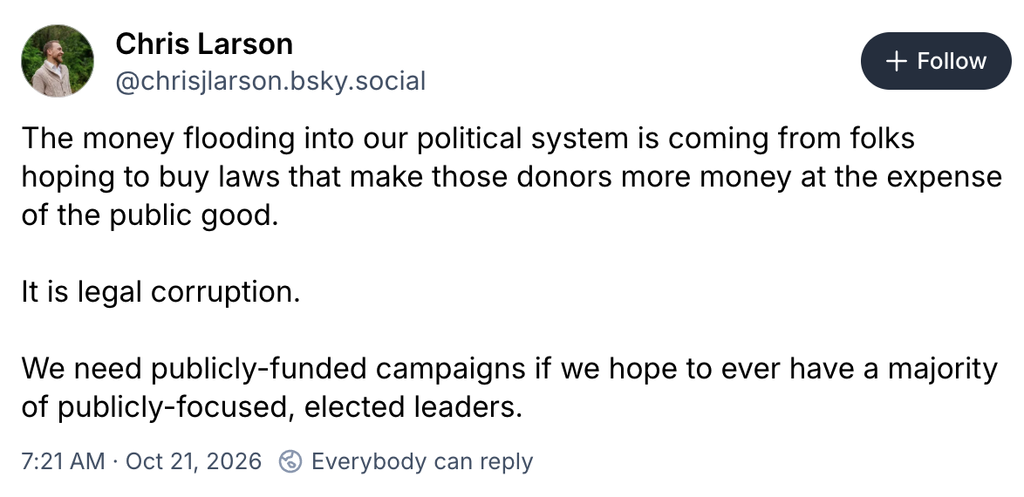
The legislation would create a so-called “Democracy Trust Fund,” financed partly through a voluntary $5 income-tax checkoff. Democrats argue publicly financing judicial campaigns would reduce candidates’ dependence on wealthy donors and special interests.
But there’s a catch.
If the voluntary checkoff fails to generate sufficient revenue, the legislation would appropriate additional taxpayer dollars from the state’s general fund. And the system is set up so that the voluntary checkoff almost certainly falls short of its goal.
That means even taxpayers who refuse to participate could end up financing judicial campaigns for candidates they personally oppose.
And the subsidies wouldn’t necessarily stop at $3 million. The legislation includes cost-of-living adjustments that could increase public funding in future election cycles.
Here’s the real kicker: The bill wouldn’t stop outside political organizations from spending millions to influence judicial elections.
Participating candidates would face restrictions on fundraising and spending, but independent political organizations could continue pouring money into races. In other words, instead of wealthy liberal donor and Epstein Island enjoyer Reid Hoffman financing judicial campaigns directly, taxpayers could pick up the tab while those same donors continue spending millions through left-wing dark money groups.
Democrats claim they want to get big money out of politics. But their proposal would leave outside spending largely intact while forcing Wisconsin taxpayers to subsidize political campaigns.
What Comes Next?
For the past 16 years, Republican legislative majorities served as a check on efforts to fundamentally reshape Wisconsin’s election laws.
That check is now gone.
Whether it’s weakening existing election safeguards, changing how presidential elections are decided, or forcing taxpayers to subsidize political campaigns, Democrats now have a clear path to advance legislation that previously stood little chance of becoming law.
The question is no longer whether Democrats have the votes to pass their election agenda. It’s how far they’re willing to go.
