



While Gen Z took the country by surprise and shifted more conservative in 2024, that pendulum has swung back after just two years. Voters ages 18-29 backed Democratic House candidates by roughly 66-72 percent in the 2026 midterms, according to CIRCLE at Tufts and the AP Voter Poll, versus about 25-31 percent for Republicans.
That margin is among the largest recorded in recent national elections and a sharp reversal from 2024, when the youngest voters were nearly split or only narrowly preferred Democrats. Young men, who had shifted toward Trump two years earlier, turned significantly left in these elections. The result powered Democratic gains in the House and Senate in every state, including here in Wisconsin, leading the way for Democrats to win a trifecta for the first time in these voters’ lives.
Let’s dig into a few reasons why.
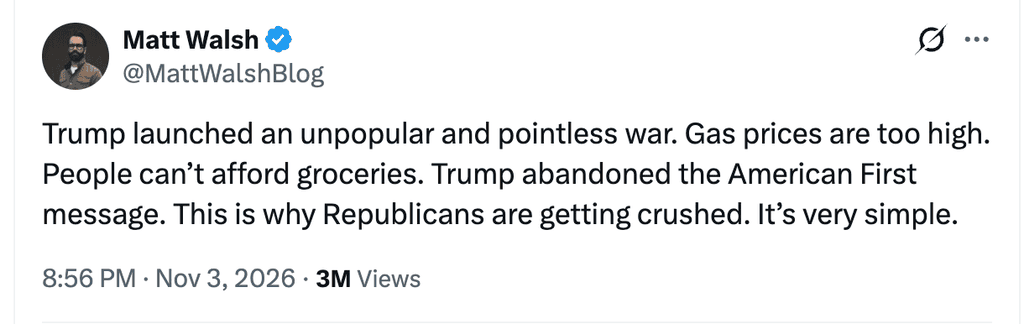
Take Matt Walsh’s post-election analysis as a primary explainer. Walsh, a prominent conservative social media influencer, and popular among young people, has been hypercritical of Trump’s Iran war, gas prices, and the affordability crisis President Trump is downplaying. These issues showed up relentlessly on the doors we’ve knocked and across age blocs and for both state and local candidates. CIRCLE data confirms: the economy and jobs ranked as the top issue for young voters, with the war in Iran also registering as a significant priority.
Their solution? Use their vote to send a scathing message to the current party in federal power…even if they don’t understand the true effect of left-wing policies: CIRCLE reported that 46% of young voters wanted “substantial change” in how the country is run and 37% wanted “complete and total upheaval” (83% combined). Those wanting major change broke heavily Democratic (71%). Combined with the high share saying they were “falling behind” economically (29%) or only “holding steady” (55%), this produced a “send a message” attitude rather than a partisan realignment.
Some of Gen Z’s voting behavior is also backlash to the older generation telling us and millennials to “stop spending so frivolously on avocado toast and DoorDash.” The response from Gen Z is almost universally, “Spare me.” You didn’t grow up in the same period as today’s young people with the same struggles. Inflation continues to drive up costs, the idea of owning a first home seems permanently out of reach, while at the same time the job market is undergoing significant transformation. Weak early-career wage growth and fears of AI-driven job displacement were flagged as driving anxiety. Only 15% of young voters said they were “getting ahead” economically.
Wages for households under 40 rose modestly in real terms over recent years while housing payments rose much faster. Advice to “just stop spending on unnecessary things and the problem will be fixed” assumes a labor and housing market that no longer exists for today’s 20-somethings. Young people are already experiencing a cost-of-living crisis with a dismal housing market that makes them feel hopeless—not just out-of-reach for the next few years, but indefinitely hopeless.
It’s not cool to be a Republican right now and that matters…social incentives are important to a generation that spends significant time in peer-driven environments.
Then there’s the makeup of conservative communities, and it’s not exactly breaking news: County party members and conservative events are mostly made up of older people. Don’t get me wrong…there are fantastic older folks in our local communities who are friendly, great leaders, and great volunteers…but one fact of life will always remain: Relatability tanks between the young and the old. Young people need companions to relate to with the same life struggles as they navigate a very confusing and defining period in their lives. People 2-3 generations ahead don’t share the same constraints, and that gap shows up in messaging and recruitment. It’s not cool to be a Republican right now and that matters…social incentives are important to a generation that spends significant time in peer-driven environments.
The 2024 results showed that Gen Z is not locked into one party. The same voters who moved left in 2026 can move again if the conservative movement takes Gen Z’s concerns seriously and finally treats affordability, housing supply, and an end to open-ended foreign commitments as core priorities.
The next step after surfacing our youngest voters’ concerns is translating that critique into a consistent political program that younger voters can see as relevant to their actual lives. This includes denouncing President Trump as a leader of our party, who’s been branded as failing to deliver on his ’24 campaign promises and has tarnished the Republican Party’s reputation indefinitely.
