


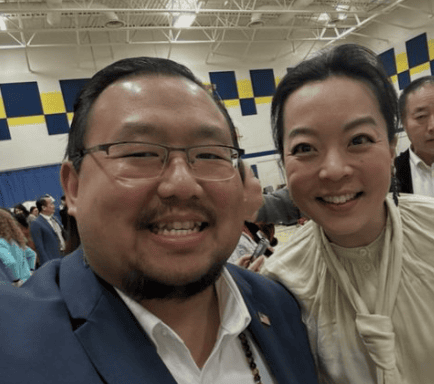
Yee Leng Xiong has told Wisconsin what kind of state treasurer he would be. A bigger one.
“It’s not the constitutional office powers that makes it an influential position,” the Democratic nominee said. “It’s what you do with that position that makes it influential.” He said Democratic control of the governor’s office and the Legislature could give him room to broaden what the treasurer can do.
In October, he went further. “We’re doing a disservice to the state of Wisconsin by doing the bare minimum,” he said.
He said this while running against Republican John Leiber, who has deliberately kept the office to its core duties. Voters should look at what that office does before they let Xiong make it “more.”
What Leiber Has Delivered
Leiber runs the smallest state treasurer’s office in the country. He has no staff. He said he has to “basically be your own staff person, your own lobbyist, your own legal advisor.”
The treasurer’s office says it is funded entirely by the unclaimed property program. “Not one single tax dollar is spent to fund the Treasurer’s office,” its website states.
The treasurer serves on the Board of Commissioners of Public Lands with the secretary of state and attorney general, which oversees the $1.6 billion Common School Fund. This year the fund paid a record $73.5 million to school libraries. Leiber says the payout has increased each of his four years, totaling more than $250 million. “Every dollar we give to school districts is a dollar that does not have to come off your property taxes,” he said.
That record came without a single new hire. Democratic Secretary of State Sarah Godlewski, who chairs the board, announced the record payout in February with Leiber at the event. Leiber helped deliver it with no staff and no tax money.
When the 2025-27 state budget let Milwaukee County keep 100% of certain traffic fines meant to feed the school fund, about $2.2 million a year, the Wisconsin Institute for Law & Liberty sued. A Waukesha County judge ruled the carve-out unconstitutional. Leiber publicly backed the ruling as a win for the fund. His plan for a second term is more of the same, on purpose. He wants the state to invest money from big legal settlements in the school fund. “Rather than spend it, I’d rather invest it,” he told WPR. “What I’m not going to do is talk about issues that have nothing to do with the state treasurer,” he told Wisconsin Watch.
Leiber is a former tax adviser at the Department of Revenue, a former legislative staffer and a former private attorney. He won in 2022 by about 38,000 votes, the same year Evers and Attorney General Josh Kaul won. If he wins again, he would be the first treasurer re-elected in nearly 25 years. The Republican Party of Wisconsin endorsed him at its May convention.
What Xiong Wants
Xiong sells himself as an “independent fiscal watchdog.” He wants the treasurer to do state audits and build transparency portals on how government money is spent.
Wisconsin already has both. The Legislature’s nonpartisan Legislative Audit Bureau audits state agencies. The Department of Administration’s OpenBook Wisconsin has posted state spending online for years. A second audit shop in the treasurer’s office would need staff, and staff needs a budget.
Then there is revenue. Xiong told WPR he wants to make sure “we’re looking at new revenues,” and he would like the office to lead the charge on exploring ways to generate new revenue. A treasurer does not create revenue. Taxpayers do. When Democrats say “new revenues,” they mean higher taxes.
He also wants the office to campaign on issues it has no part in. He said refusing to expand Medicaid is “fiscally irresponsible” and that he would use the treasurer’s office visibility to highlight its costs. That is a fight for the governor and Legislature. Xiong wants a taxpayer-funded office to join it.
A Campaign Built for the Party
Xiong is not waiting for the job to start picking fights. On October 9, he and the Democratic Party of Wisconsin sued the Trump administration in federal court in Washington over about $20 million in Homeland Security ad spending. The treasurer has no role in federal ad budgets. The suit puts a down-ballot candidate’s name on a Democratic Party lawsuit less than a month before the election.
His political circle leans hard left. Socialist State Rep. Francesca Hong was one of his loudest backers in his 2024 Assembly race, posting that he was “running to flip the 85th.” Xiong lost that race to Republican Rep. Patrick Snyder, 53.2% to 46.7%. Last year he went to a Hong campaign meet-and-greet “to hear ideas firsthand,” while calling himself “(painfully) neutral” in the governor’s primary that Hong went on to lose.
This month he posted that he was “proud to join over 1200 people in Eau Claire for No Kings Day,” the anti-Trump protest series.
In March 2020, as Weston Village trustees, he and Nathan Fiene introduced a resolution opposing U.S. talks with Laos over deporting Hmong and Lao nationals. He described those at risk as people who “made mistakes when they were in their teens and early 20s, served their sentences.” “This is their home,” he said.
In Marathon County, he chaired the Diversity Affairs Commission and pushed its “Community for All” resolution. He preferred the version closest to the original “No Place for Hate” draft. After a fight over the word “equity,” the county board rejected the final version in an 18-18 tie in August 2021. Marathon County was not buying what Xiong was selling.
Xiong already holds two local offices, on the Marathon County Board and the D.C. Everest school board. He launched his statewide campaign on January 7, then asked voters for another school board term on the April ballot and won. Voters who re-elected him deserve to know which job he actually wants.
The Choice Is Easy
The treasurer’s job is narrow: guard the school trust fund. Leiber has done that, and the school fund payout has gone up every year he has been there.
Xiong is offering a bigger office with a bigger agenda, built for a Democratic trifecta. In Madison, “more” always costs the taxpayer. Leiber has earned a second term. Voters should give him a second term on Tuesday, November 3.
