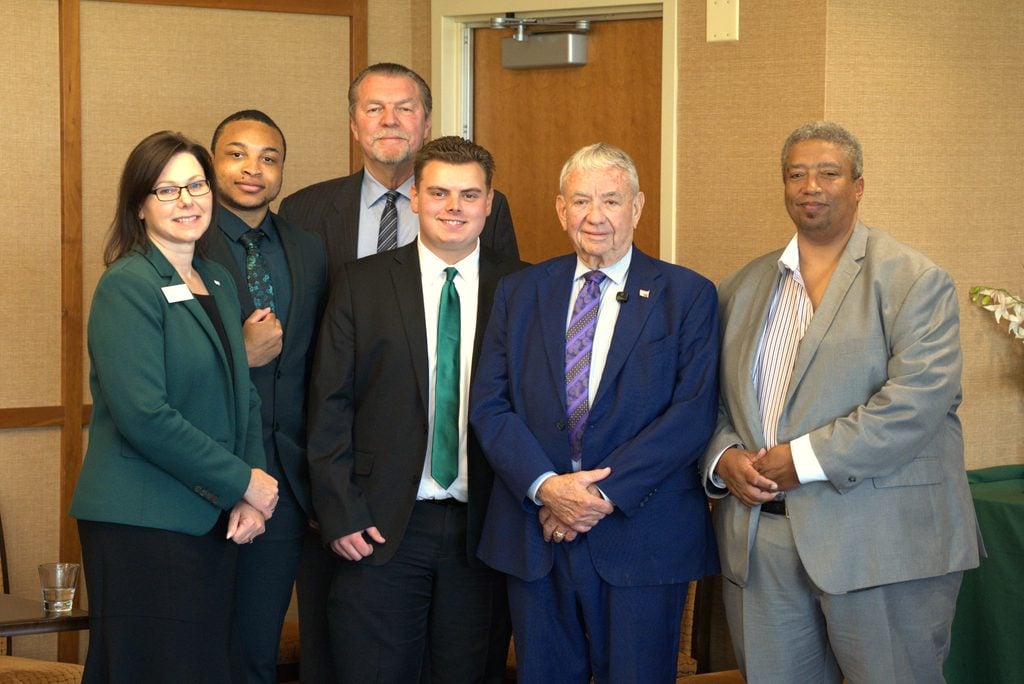


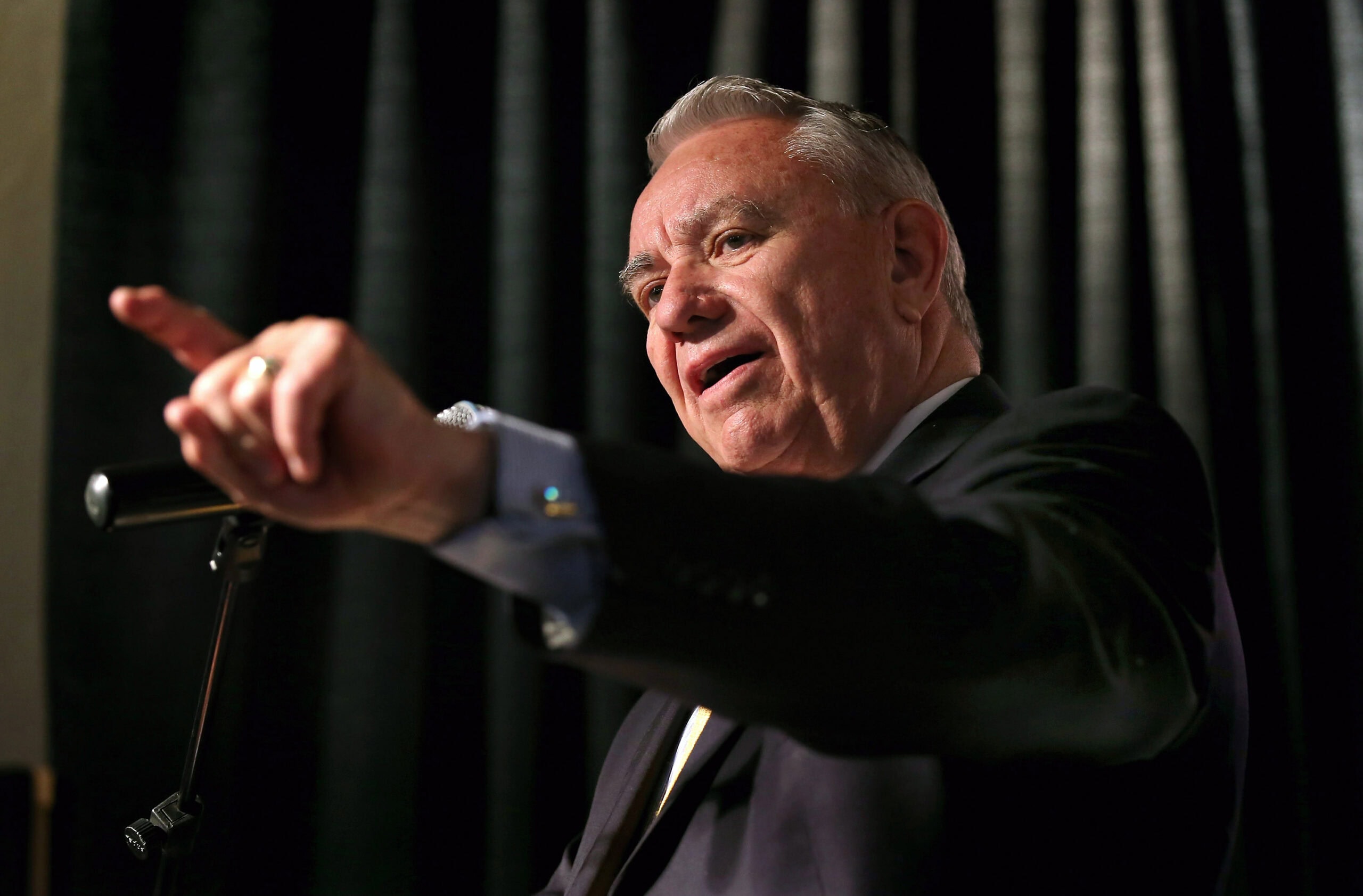
Former Wisconsin Governor Tommy Thompson spoke about his experience on September 11, 2001 — 25 years later at a 9/11 Remembrance Event hosted by UW-Parkside, Student Body President Luke Smith and Vice President Jonathan Egwu. Both offering opening remarks about the historical importance of 9/11, followed by Kenosha Videographer Elishai Riley and Kenosha Alderman Anthony Kennedy. State Rep. Bob Wittke also shared his experiences surrounding 9/11and having the responsibility to teach younger generations about what happened that day before introducing Thompson.
Tommy Thompson was serving as Secretary of Health and Human Services during 9/11 — and he walked the audience through what he had endured that day. Thompson recalled a meeting that morning where he was scheduled to discuss a new flu vaccine with a group of scientists when the first tower was hit.
“We were having breakfast, then somebody tapped me on the shoulder and said you got to take an emergency call, and I did. You’ve got to leave immediately. You’ve got to get back to the office,” said Thompson.
The HHS office was inside The Humphrey Building, which is located in Washington, D.C. on Independence Avenue near the Capitol Building. Flight 93 — the plane that crashed in Shanksville, PA — was originally set out to crash into the Capitol Building that day, a fact that still haunts him 25 years later.
When he returned to the office, he was briefed by his staff, which was comprised of government officials, lawyers, public relations staff, and others who were there to advise him of what was happening.
“A plane flew into the North Tower. American Airlines number 11 at 8:46. It was odd — why would a plane fly into a building in New York that stands over 100 stories high? Pretty hard not to see it,” he said.
“It flew into the upper part of the North Tower. At 9:07, United Airlines 175 flew into the South Tower, in the middle of the tower. We’re watching this on television, as most Americans were, and we knew were were under attack.”
Only 56 minutes after the South Tower was hit did it begin to collapse. “The reason the South tower collapsed before the North tower because it got hit in the center,” he pointed out.
“There were thousands of people in each one of those towers. Thousands of people working, some government officials, some of my people from Department of Health and Human Services was working there,” he recalls. “One stock broking company on the 101st floor, [it] wiped out all of their employees.”
He called in his lawyers to discuss declaring a national public health emergency for the first time in our nation’s history so HHS could access the medical stockpiles for the injured. There were eight secret depots around the country holding roughly 50 tons of supplies each.
“You knew there was going to be fatalities, you knew there was going to be injuries. And then people starting jumping out of the windows, killing themselves instead of burning up.”
“Has anybody ever declared a health emergency in the United States?” Thompson asked his attorneys. “Not that we can find,” they replied.
“Can I declare a national health emergency?” he asked. The attorneys said they didn’t know. “Well go find out!”
They came back in 15 minutes and said, “We don’t know if you can, but we don’t know if you can’t.”
“Well then we do it” said Thompson. “You’ve got to act when you’re under tremendous stress in an emergency like this.”
Then the Pentagon was hit. Nearly thirty minutes later, a plane crashed in Shanksville, Pennsylvania.
“I don’t think there’s ever been a secretary that called a National Health Emergency in America. I probably didn’t have the legal rights, but I said don’t give me a reason why I can’t. Give me a reason why I can and do it.” By 10 a.m. it was done.
Vice President Dick Cheney called Thompson and asked, “What are you finding out Tommy?” He told the VP everything he knew thus far, then called the New York City Mayor, Rudy Giuliani, and told the Mayor he would have medicine sent immediately.
President Bush had already been relocated to the White House bunker and ordered cabinet secretaries to Mount Weather Emergency Operations Center, the underground complex in Virginia built for continuity of government. Thompson did not want to go and wanted to stay in Washington while he was trying to move teams and supplies.
“I told him I wouldn’t go. My job was here, I’ve got to take care of the people who are sick and injured.”
Word came back from POTUS that he did not have a choice. “All of the other secretaries were already there and were mad as hell that I wouldn’t come. They were hot, but I didn’t want to leave my post,” Thompson said. Helicopters were leaving at 1 p.m. and he was told he had to be on one of them.
He originally wanted to defy orders, but staff members talked him out of it. He agreed to go, then pulled aside Mike Lonetto, a member of his security detail. “Find out where Mount Weather is” Thompson told him. “After I leave, drive out there. I am going to find a way out of there, and you are going to drive me back.”
At Mount Weather, they signed him in and assigned him a room. He threw his sleeping bag on the bed and walked around until he found a back entrance where Lonetto was waiting. Thompson jumped into the back of the car and said, “Get me to my office.” They were back at the Humphrey Building by 4:30 p.m. The audience laughed.
Thompson and HHS got a plane in the air after the rest of the civilian fleet was grounded. He coordinated with the CDC and supplies reached New York by 5 o’clock that afternoon.
Thompson recalled how his staff was terrified. “Several went home that day, but many stayed because I asked them to, and I wanted to be there to shake their hands and to thank them for their dedication and duty, and doing what was right.”
He stood at the main entrance shaking hands with his employees until everybody left for the day, telling them “I hope you come back tomorrow.”
“I didn’t hardly go to sleep that night. I camped out in my building,” said Thompson. The next day, staff started to arrive at 5:00 in the morning and got straight to work moving equipment and supplies to the crash sites. “I decided I’ve got to go to New York.” He took the Amtrak to New York with two aides and was the first cabinet secretary on the ground.
Mayor Giuliani’s police took them to Ground Zero. “The stop-and-go lights were blown out,” he recalled. “No one honked. Have you ever been to New York when you never heard a horn honk?” The audience laughed.
Dust and debris blacked out the sun. Particles fell on the people working in the pile. He walked over to the crash site to speak with police, firefighters and EMTs. He shook their hands and thanked them. “They were helping each other like Americans always do,” he said.
The hardest stop was the chief medical examiner’s office. Families were arriving with hairbrushes, toothbrushes, dental records, teeth. They were trying to identify what was left of the people they loved.
“This was the saddest thing I think I’ll ever endure,” Thompson said. “I was crying most of that afternoon. All I can tell you was it was surreal.”
He has said more than once that it was obvious the air itself would hurt people later. Thompson said at the American Beverage Association meeting in Madison on 09/10/26, “I mean, you didn’t have to be too smart to realize that some people were going to be adversely impacted. I mean, the amount of debris that was coming out of the sky, was just dismal. You can’t discount it, because I saw it. I was witness to that. It was obvious that the people were going to be adversely impacted, health-wise.”
What stayed with him as much as the wreckage was the way people behaved. In New York, cars waited their turn at dead intersections. The city was visibly shaken, eerily quiet and mourning. In Washington, senators who barely spoke to each other were hugging. Democrats, Republicans and Independents stood together and sang Patriotic songs.
“It’s hard to put it into words the feeling, the emotions, the hatred, the sorrow that America was attacked. Nobody could ever believe that, and people of all walks of life, all political persuasions were out the window.”
The audience listened raptly to Thompson’s first-hand account of the tragic events that occurred that day. It was a particularly moving story told by the beloved Governor and fellow Wisconsinite. They hung onto every word. Full Video by Elishai Riley — Riley Productions: https://www.facebook.com/share/v/1DnSrfxJTc/
Photo: Logan Sajdowitz
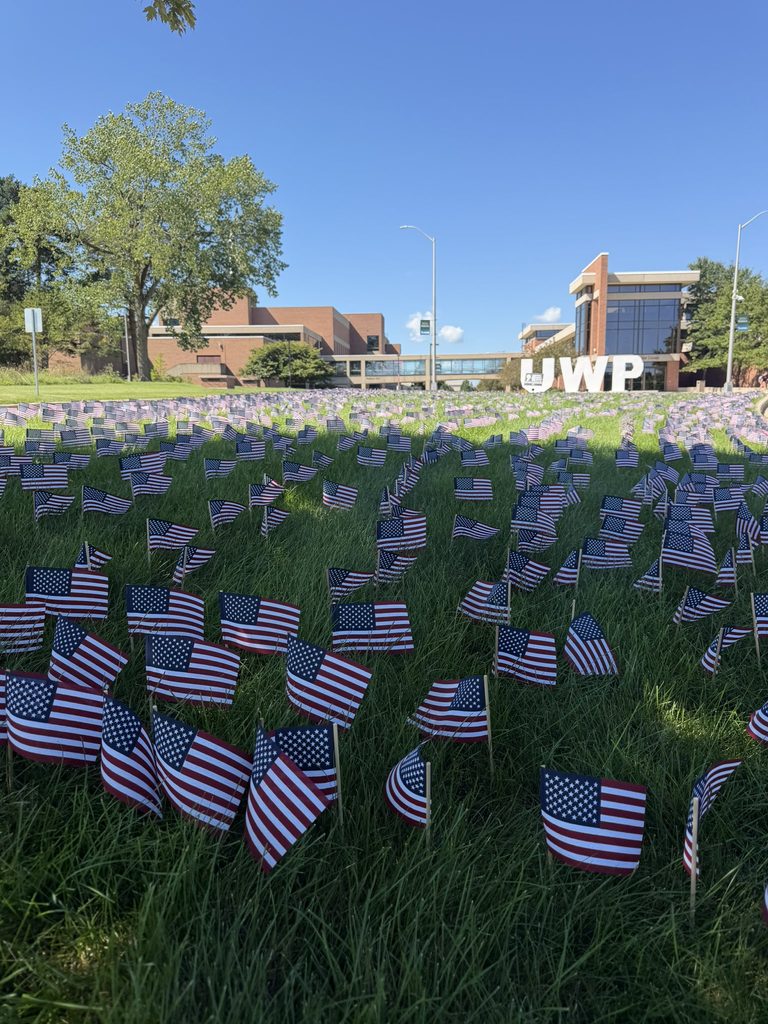
Photo: Elishai Riley