


Wisconsinites are increasingly looking for better returns on their tax-dollar investments, especially in education. With stories of waste, fraud, and abuse hitting the news cycle weekly, working people’s distrust in government is rapidly growing. When less than one third of Wisconsin fourth graders can read or do math at grade level, and we have declining enrollment statewide, they wonder why it costs more to educate fewer students and what they are actually getting for their money.
When the perceived value of a four-year degree is at an all-time low across most demographics and across the political spectrum, taxpayers are growing frustrated that the UW System continues to ask for more money instead of taking meaningful steps to control costs. When the Board of Regents keeps approving tuition increases – after stating publicly that they were not happening – that public distrust balloons, and students are the ones whose bubbles get burst.
I’m frustrated, too, which is why I fought hard to include significant UW policy reforms in the current state budget. Republicans successfully negotiated to get mandatory general education credit transfer between all UW schools – including Madison – saving students both time and money while increasing their access to opportunity. Going forward, faculty will have minimum teaching hour requirements so that students are getting what they paid for, not just instruction from teaching assistants and grad students. New money in state general purpose revenue will be distributed to campuses with strings attached, not through a block grant with no accountability. To prevent further administrative bloat, the number of UW positions are now frozen. These are steps in the right direction, but we have a long way to go to reach meaningful reform.
The University of Wisconsin System has a spending problem, not a revenue problem. The ratio of administrators to students at UW Madison is 1:3, and it’s 1:4 System-wide. There are 13 campuses, all of which offer similar programming, resulting in redundant spending and competition between UW institutions at the expense of taxpayers. Because admission standards have increasingly been based on criteria other than merit, the costs of “wrap-around services” to support students who enroll but are not actually prepared for college-level academic rigor have skyrocketed.
In his August 2024 testimony before the Legislative Council Study Committee on the Future of the UW System (which I chaired), former System President Jay Rothman described concerning demographic and declining enrollment challenges that are driving increased spending, noting that participation in four-year degree programs is waning. He emphasized that cost is the number one barrier preventing prospective students from pursuing post-secondary education options. Despite this data, the Regents approved a 2% tuition increase last week, after their 5% increase last year. If cost is the number one barrier to a college education, why not look for more ways to curb spending rather than increasing tuition? With all that top-heavy bloat, it shouldn’t be hard to find some fat to cut.
The UW illustrated that they can, in fact, operate more efficiently under the leadership of former President Jay Rothman. Spearheading System’s strategic plan, his vision helped all thirteen campuses overcome structural deficits amid sharply rising costs in a relatively short amount of time. The question is, could the UW do even more to reduce spending instead of increasing tuition? In my opinion, they not only could do more, they must drastically restructure if the institution is going to survive and adequately serve our state into the future.
The Study Committee was comprised of a wide array of stakeholders from around Wisconsin, including former regents, faculty, business owners and leaders, and legislators, to name a few. Their report of recommendations to the Legislature reflects a commitment to higher education as an investment in meeting the workforce needs of our evolving state economy, not in funding monolithic ideological ideas that stoke the fires of partisanship and divide. The committee outlined ways the UW could reallocate existing resources to better serve students and taxpayers, rather than continually coming to the Capitol with its hand out for more funding while treating accountability as an inconvenience. Perhaps the regents should re-read that report in light of recent events.
The UW needs to spend smarter, not harder. Consolidating programming regionally would reduce redundant spending while preserving educational access for students around the state. Since it hasn’t been updated in 50 years, the distribution formula of state GPR to each campus must be overhauled to provide a fair distribution that reflects modern enrollment, not what it was in the 1970s. Time is money, and we need to consider helping students get through college faster by offering things like three-year degree programs and improved transfer processes. Lastly, we know that the cost of an engineering degree is significantly higher than for a teaching degree. Allowing institutions to set tuition based on the cost of a program of study, rather than a universal base price for all students, would give them the opportunity to be more competitive and better manage their fiscal planning.
If the UW is going to succeed in the decades to come, they cannot solely rely on increasing enrollment at a time when birthrates are declining and the interest in a traditional four-year degree is plummeting. They can start by reforming their governance model to separate UW-Madison from the comprehensive campuses so that the big fiscal picture is not continuously muddied by the success of the flagship mixed with the uncertain future of campuses teetering on the edge of survival. The Legislature could then make separate, more accurate, budget appropriations that better reflect the actual costs of both bodies.
In today’s modern market, young people are way too savvy to fall for the myth that you need a college degree to be successful. They are increasingly making alternative choices, and the UW System is falling behind. Raising tuition simply kicks the can down the road and funds the status quo. The time to embrace reform is now.
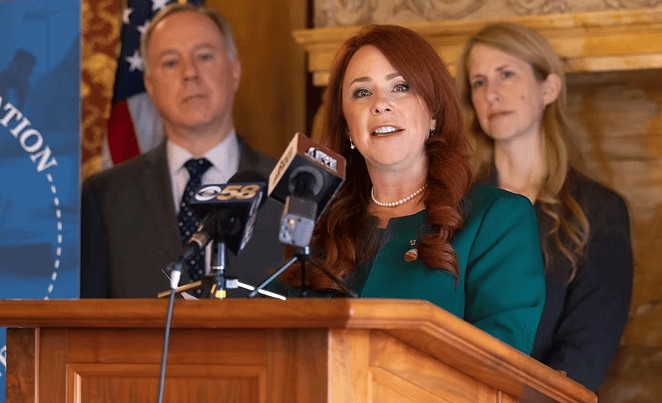
Amanda Nedweski (R-Pleasant Prairie) represents Wisconsin’s 32nd Assembly District. She is currently the Vice-Chair of the Assembly Committee on Colleges and Universities and previously chaired the Legislative Council Study Committee on the Future of the University of Wisconsin System.
